RESOURCES · SECURITY CAMERAS
IP vs analog cameras: which to choose for your business or home?
IP cameras are the standard choice in 2026 — better resolution, a single cable with PoE, and AI analytics. Modern analog cameras are still valid when coaxial wiring is already installed.
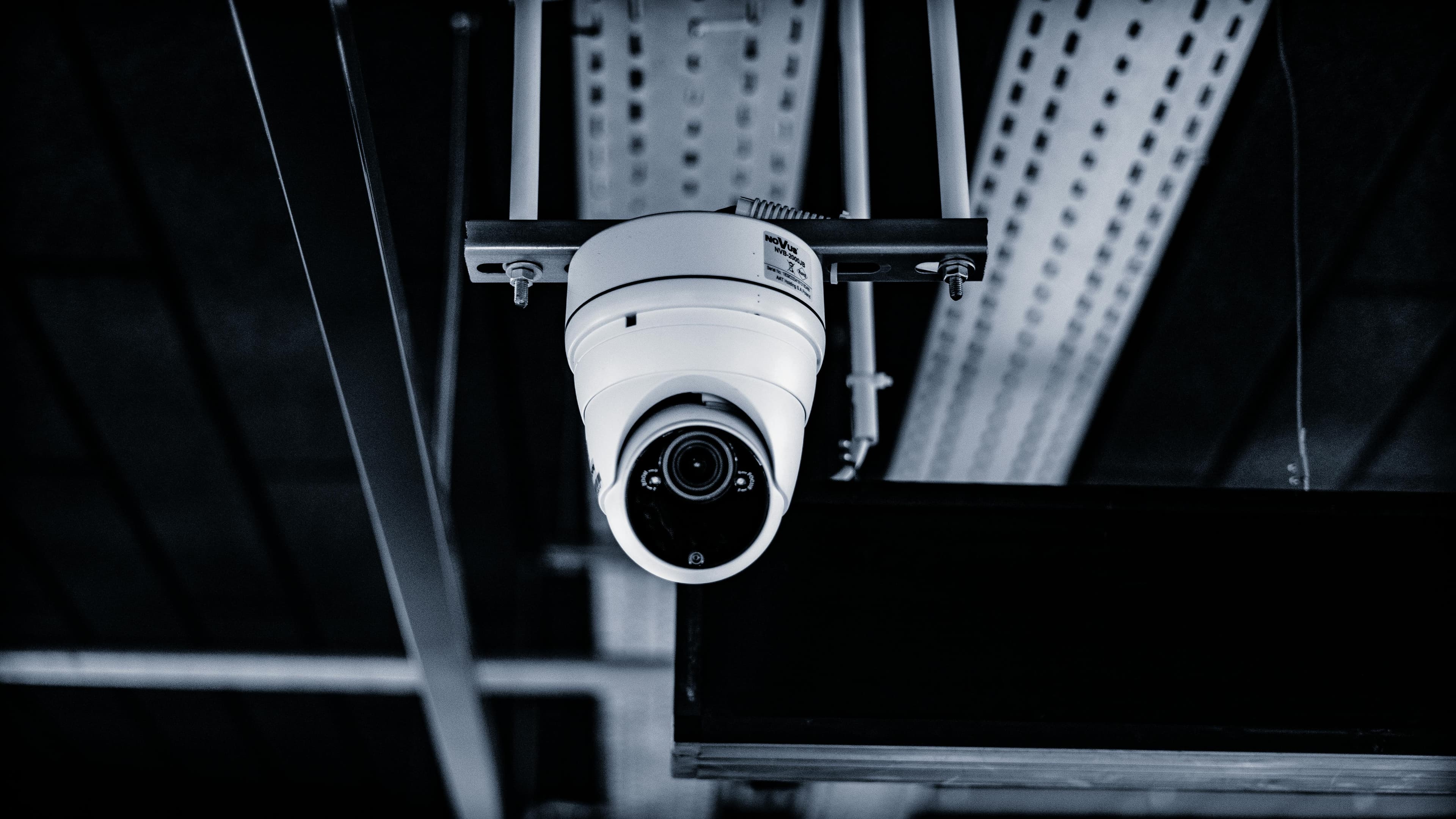
IP cameras transmit digital video over an Ethernet network (UTP cabling) and record on an NVR (Network Video Recorder). Analog cameras transmit an analog signal over coaxial cable and record on a DVR (Digital Video Recorder). In 2026, IP cameras are the standard choice for new installations — they offer higher resolution, scalability, artificial-intelligence (AI) analytics, and a single cable that carries data and power thanks to PoE (Power over Ethernet) technology. Analog cameras remain a valid option to update sites with existing coaxial wiring that you don't want or can't redo.
This article explains the difference between IP and analog cameras, compares their advantages and limitations honestly, and offers a practical four-question guide to help you make the right decision for your site. It is written by the technical team at E3 Solutions — certified installer of Bolide systems in Guatemala.
Ready to get a quote?
See the E3 security camera system → · See the Bolide model catalog (IP and coaxial) →
What is an IP camera?
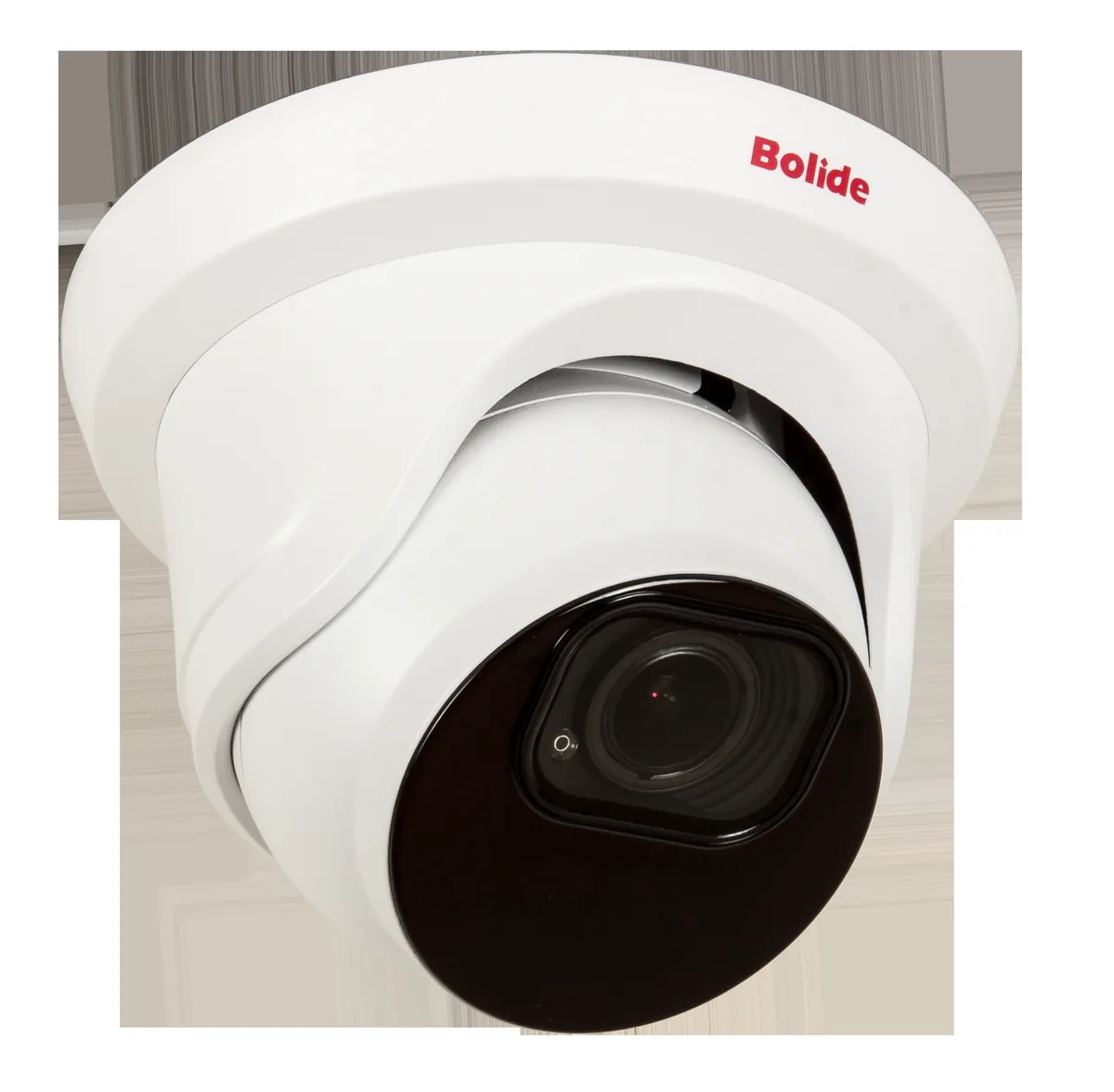
An IP camera is a digital camera that has its own IP address and connects directly to the data network via Ethernet cable (UTP, RJ45 connector). Unlike traditional systems, a single Ethernet cable carries video, control commands, and power — the latter thanks to PoE (Power over Ethernet), which eliminates the need for a separate electrical run. Video is recorded on an NVR. Modern IP cameras use the H.265 (HEVC) codec, which reduces file size to about half that of H.264 without losing quality or resolution. Available resolutions start at 2MP (1080p Full HD) and go up to 5MP and 4K. They can also run artificial-intelligence analytics directly on the camera — facial recognition, license plate recognition (LPR), people and vehicle detection, counting, heat map, and perimeter intrusion, among other functions.
What is an analog camera?
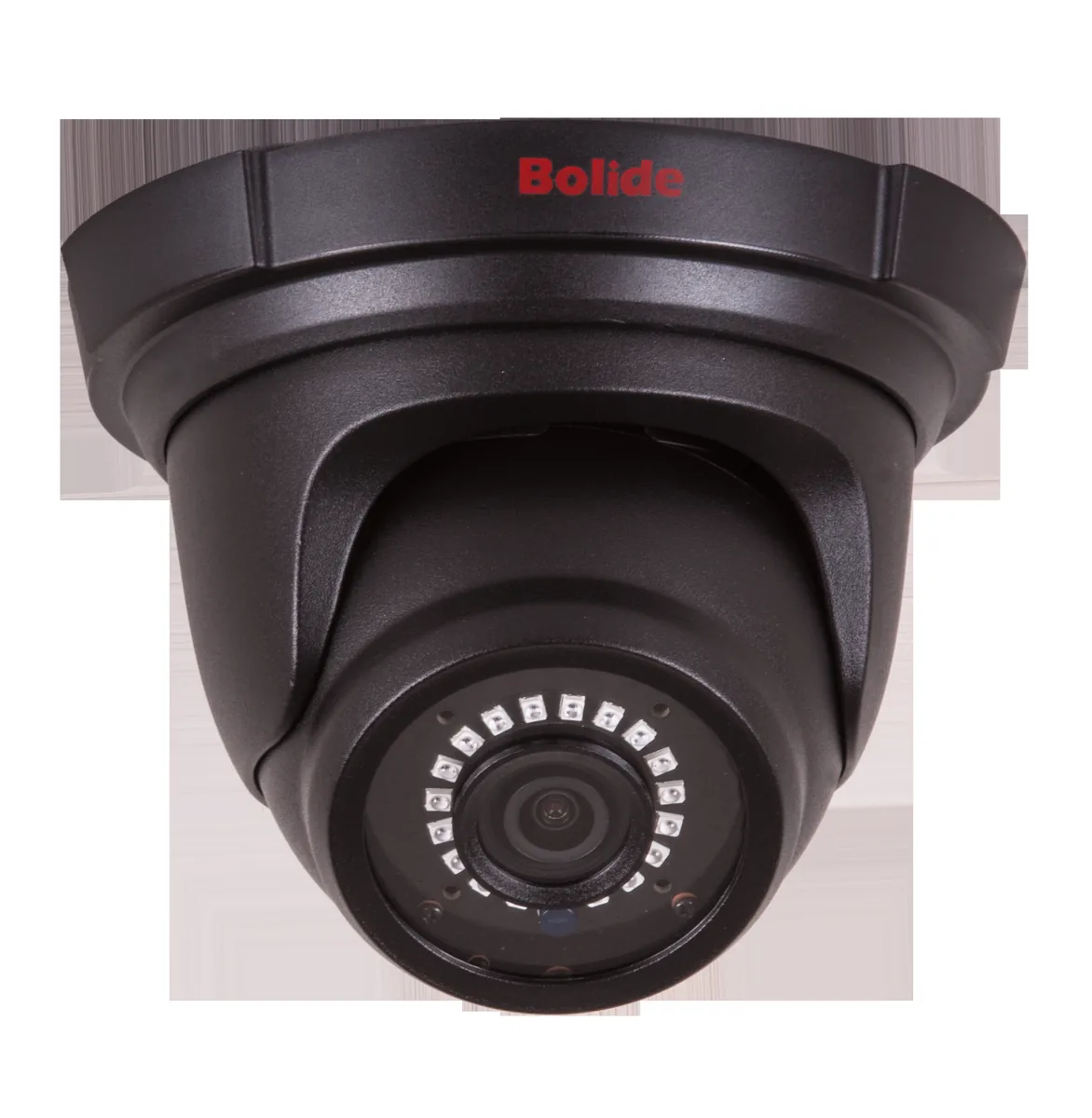
An analog camera transmits the video signal in analog format through coaxial cable (typically RG59). It also requires a separate power cable (12V DC or 24V AC), which means two physical runs per camera. The signal is digitized when it reaches the DVR (Digital Video Recorder), which is the system's recorder. Modern coaxial technologies — HD-CVI, HD-TVI, and AHD — have raised available resolution to as high as 5MP over the same existing coaxial cable, making modern analog cameras a realistic option when wiring is already installed. Bolide offers the Angelo line (5MP over coaxial) and the BTG value line (2MP over coaxial) for this scenario. The most frequent use case: upgrading an already-installed CCTV system without the cost or work of redoing the wiring.
Side-by-side comparison
| Aspect | IP cameras | Analog cameras |
|---|---|---|
| Signal type | Digital (over Ethernet network) | Analog (over coaxial cable) |
| Cabling | UTP / Ethernet (Cat5e/Cat6) — one cable carries video + power with PoE | Coaxial cable (RG59) + separate power cable |
| Recorder | NVR (Network Video Recorder) | DVR (Digital Video Recorder) |
| Typical resolution | 2MP, 5MP, 4K and above | Standard 1080p; up to 5MP with HD-CVI/HD-TVI |
| Modern codec | H.265 (half the storage of H.264) | H.264 / H.265 depending on the DVR |
| Maximum distance without amplifier | ~100 m per Ethernet run | ~300 m coaxial (clean signal) |
| Power | PoE — a single cable | Separate power source |
| Remote access | Native (web, mobile app) | Via DVR with a network connection |
| Scalability | High — adding cameras is configuring a new IP | Limited — each camera requires a new coaxial run to the DVR |
| AI analytics | Supported on the camera (iPac AI on Bolide IP lines) | Limited or only on the DVR |
| ONVIF compatibility | Yes (industry standard) | Not applicable |
| Equipment cost | Higher | Lower |
| New installation cost | Lower (one cable, no additional electrical run) | Higher (two runs per camera) |
| Leverage existing wiring | No (requires UTP) | Yes (if coaxial is already installed) |
| Full-color night vision, two-way audio, active deterrence | Available in modern lines (Bolide iPac AI) | Available in modern lines (Bolide Angelo SniperMax) |
| NDAA compliance | Available (NDAA-compliant Bolide IP lines) | Available (Bolide coaxial lines) |
Advantages of IP cameras
For the vast majority of new installations in 2026, IP cameras are the right choice. These are the concrete reasons:
- Higher resolution — native 4K, ideal for identifying faces and license plates at a distance. Where a traditional analog camera cannot make out a plate number at 10 meters, a 5MP or 4K IP camera does.
- A single cable (PoE) — video, control, and power in a single Ethernet cable. Less material, less labor, fewer failure points in the installation. The run is cleaner and faster.
- Scalability — adding a camera to the system is a matter of configuring a new IP address on the network. There is no need to run additional coaxial cable to the recorder; just connect to the nearest PoE switch.
- AI analytics on the camera — facial recognition, LPR, people and vehicle detection, heat map, line-crossing counts, and perimeter intrusion are processed directly on the camera, without depending on an external cloud service. On the Bolide iPac AI lines, this analytics capability is part of the equipment hardware.
- H.265 compression — reduces required storage by half compared to H.264 without loss of image quality or fluidity. Critical when disk space is limited or you want to extend the retention period of recordings.
Advantages of analog cameras (when they still make sense)
Not every situation justifies a new installation with UTP cabling. There are four scenarios where modern analog cameras remain the most sensible decision:
- Reuse of existing wiring. If your site already has RG59 coaxial wiring installed from a previous system, a 5MP camera over coaxial (such as those in the Bolide Angelo line) raises the resolution to a modern level without re-cabling work. The return on investment is much faster.
- Lower equipment cost per camera. For sites where the budget is tight and AI analytics is not a requirement, value-range analog cameras (Bolide BTG line, 2MP over coaxial) cover basic surveillance needs at a lower equipment cost.
- Longer cable runs. Coaxial cable can run approximately 300 meters with a clean signal without an amplifier; Ethernet without a repeater reaches about 100 meters. On very extensive perimeters — farms, large warehouses, industrial facilities with separated areas — this difference matters when there are no intermediate cabinets to install switches.
- Network simplicity. If the organization does not have robust network infrastructure or does not want to depend on it, a DVR + coaxial system operates more autonomously. It does not depend on the PoE switch being up for the cameras to record.
Honest drawbacks
Limitations of IP cameras
- Higher upfront equipment cost: IP cameras, the NVR, and the PoE switch represent a higher entry investment than an analog system with the same number of points.
- They require stable network infrastructure. If the network fails or the PoE switch is off, the cameras stop recording (mitigable with a local NVR with its own disk, which records autonomously even if remote access is cut).
- Configuration is more technical. A non-certified installer can leave errors in IP addressing, VLAN configuration, or remote access that compromise system operation.
Limitations of analog cameras
- The practical maximum resolution is lower than that of a mid-range IP camera, even with HD-over-coaxial technologies.
- AI analytics, when present, lives on the DVR — not on the camera — and tends to be more limited in functions and in the number of simultaneous channels.
- Each camera point requires two cables (coaxial + power), which increases material cost and run complexity on new installations.
What about AI integration? The factor that changes the conversation
AI analytics is today one of the deciding factors that separates IP systems from analog ones. Features such as people vs vehicle detection, facial recognition with a database, multichannel LPR, traffic heat map, abandoned-object detection, perimeter intrusion, and line crossing are available on modern IP cameras — and on Bolide iPac AI systems they run directly on the camera, not as a cloud service, which improves privacy and reduces dependence on a stable internet connection.
Traditional analog cameras do not incorporate this analytics. Some modern hybrid DVRs include basic analytics at the recorder level, but capabilities are more limited in the number of simultaneous channels and in the depth of the available functions.
The practical result: fewer false alarms, fast searches across recordings by face or license plate, and actionable reports — not hours of video no one reviews.
How to decide in 4 questions
If you are still unsure which technology suits you, answer these four questions in order:
1. Are you installing a new camera system with no preexisting wiring?
- Yes → Choose IP cameras. A new installation with UTP and PoE is simpler and, in most cases, more economical than running two cables for each camera point.
- No (I already have coaxial wiring installed) → Continue to question 2.
2. Do you want to keep your existing coaxial wiring?
- Yes → Modern analog cameras over coaxial (5MP, Bolide Angelo line). Raises the resolution without redoing the installation.
- No (willing to re-cable) → IP cameras.
3. Do you need AI analytics — facial recognition, LPR, counting, heat map?
- Yes → IP cameras (Bolide iPac AI).
- No → Either technology can work for you.
4. Does your site have a stable network and a technician to maintain it?
- Yes → IP.
- No → Consider analog cameras; they are more autonomous and do not depend on the network's state to record.
If you still have doubts, a technical visit resolves the decision: we evaluate wiring, coverage, and security objectives, and recommend the right combination. See the E3 Solutions camera system →
The E3 option — Bolide IP and Bolide coaxial, both NDAA-compliant
E3 Solutions distributes and installs Bolide cameras in Guatemala in both lines: IP — with the iPac AI 5MP and 4K series — and 5MP coaxial with the Angelo line. Bolide Technology Group is a US manufacturer headquartered in San Dimas, California; its iPac AI and NDAA lines comply with Section 889 of the National Defense Authorization Act (NDAA), the US national security regulation that restricts the use of video surveillance equipment from certain brands in government facilities and US government contractors. If your company has ties to the US market — parent companies, export contracts, franchises, or regional chains headquartered in the US — choosing NDAA-compliant equipment removes that risk in the supply chain. For everyone else, the underlying reasons apply equally.
If you are just getting to know this topic: read **What is NDAA and why does it matter in Guatemala?** to understand the full context.
Conclusion
In 2026, IP cameras are the right choice for the vast majority of new installations: better resolution, a single cable per camera, easy scalability, and integrated artificial-intelligence analytics. Modern analog cameras over coaxial remain valid when there is already installed infrastructure that should not be redone. The final decision always depends on your site, your budget, and your security objectives — and that is best evaluated on an in-person technical visit.
If you are comparing brands as well as technologies, read **What is NDAA and why does it matter in Guatemala?**
Frequently asked questions
Request a no-commitment technical visit
We evaluate wiring, coverage, and security objectives, and recommend the right combination of Bolide IP and analog cameras for your site.