RESOURCES · EMOTRON
What is a soft starter and how does it work?
An electronic device that controls the start and stop of a three-phase motor, reducing the inrush current peak and mechanical stress. This guide explains what it does, how it works, and when it is the right fit.
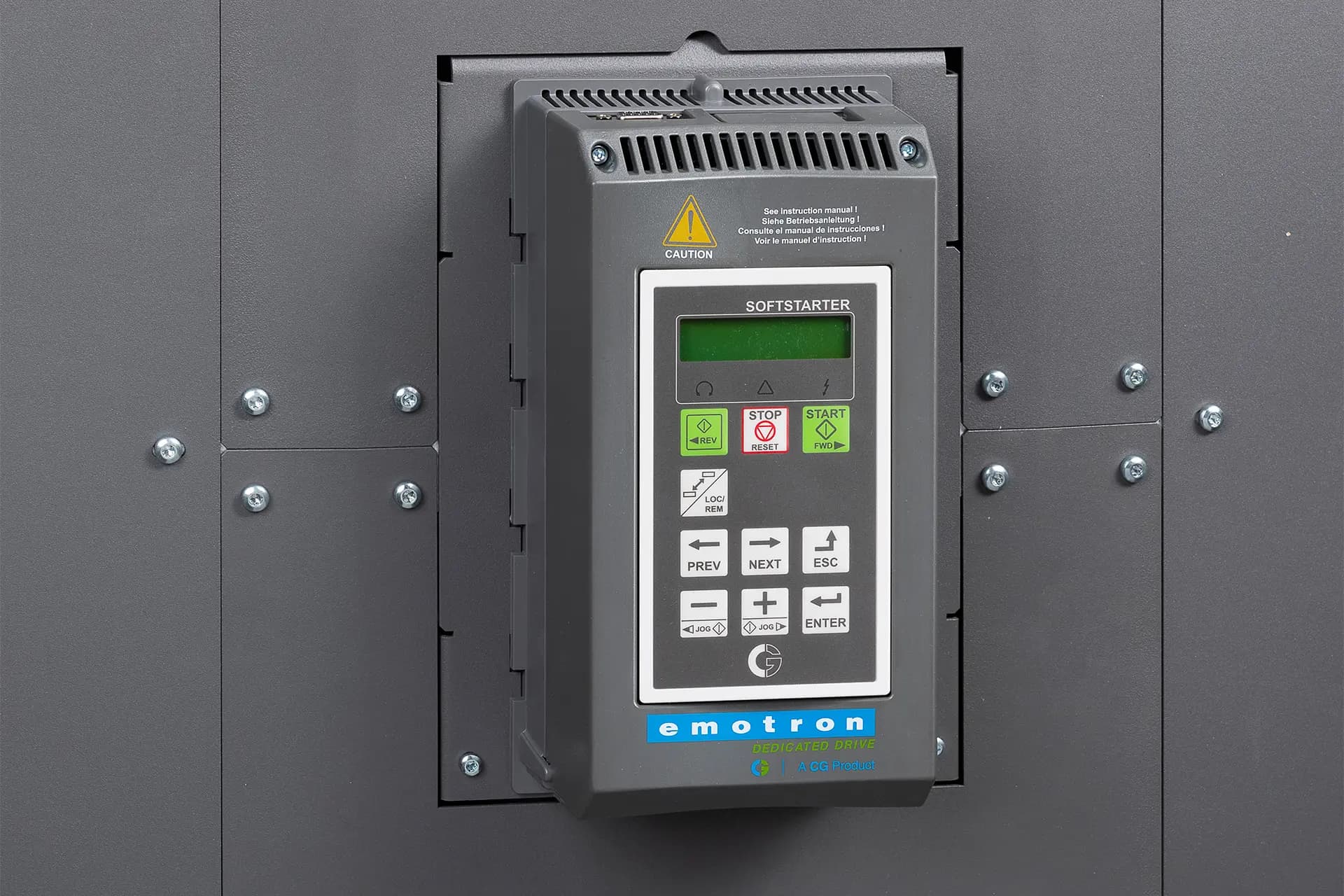
A soft starter (in English, *softstarter*) is an electronic device that controls the start and stop of a three-phase induction motor, reducing the inrush current and mechanical stress on the equipment. Unlike direct-on-line (DOL) starting, where the motor receives full voltage at once, the soft starter ramps voltage up gradually, allowing the motor to accelerate in a controlled way until it reaches nominal speed.
This guide is aimed at plant engineers, maintenance managers, electrical contractors, and owners of industrial facilities who have heard the term and want to clearly understand what this device does, how it works, what its real benefits are, and in which applications it makes sense to use it. It is prepared by the technical team at E3 Solutions, the official Emotron distributor in Central America.
If you already know the concept and want to evaluate a specific model, see the Emotron TSA soft starters →. If you are comparing options for your process, first read Variable frequency drive vs soft starter →.
What does a soft starter do exactly?
The main function of a soft starter is to control the voltage the motor receives during start and stop. Instead of applying line voltage immediately — which generates a current peak of between 5 and 8 times the motor's nominal current — the soft starter ramps it up progressively along a programmed curve. The practical result is a gradual start: the motor accelerates without jolts, the inrush current is significantly reduced, and the starting torque is controlled throughout.
On stop, the process is reversed: voltage is reduced gradually instead of cutting power abruptly, which prevents both coast-down (which can be harsh on inertial loads) and water hammer in pumping systems. All of this translates into considerably less stress on the motor, belts, couplings, bearings, and the electrical grid. Panel protections stop tripping due to the inrush peak at start.
Discover the features of the Emotron TSA →
How does a soft starter work?
The internal mechanism of a soft starter is based on thyristors (SCRs) connected in an antiparallel configuration on each of the three phases of the motor. Through firing-angle control, the SCRs allow only a portion of each half-cycle of the AC waveform to pass, thereby regulating the effective voltage reaching the motor at any given moment.
The step-by-step process is as follows:
- When the start begins, the firing angle is set to allow only a small fraction of the total voltage. The motor starts slowly and with reduced torque.
- The firing angle opens progressively, following the configured ramp. Voltage rises gradually and the motor accelerates in a controlled way.
- Once the motor reaches nominal speed, the internal bypass — included as standard on soft starters such as the Emotron TSA — short-circuits the SCRs. From that point on, the motor operates directly from the grid, with no additional losses from the semiconductors.
- For the stop, the process is reversed: the firing angle closes gradually, voltage drops, the motor decelerates in a controlled way, and stops without jolts.
This mechanism is entirely electronic, with no moving parts involved in switching, which makes it more reliable and lower-maintenance than conventional electromechanical solutions such as star-delta starting.
See how the Emotron TSA implements this principle →
Benefits of the soft starter
Installing a soft starter instead of a direct-on-line or star-delta start is not just a technical decision: it is an economic one. Below are the six main benefits that directly impact your plant's operating and maintenance costs.
- Lower inrush current. The inrush peak is significantly reduced — on the Emotron TSA, by up to about 30% (source: EMOTRON.md). This allows you to size fuses, cables, and contactors at a smaller rating, reducing the cost of the electrical installation from day one. In plants with multiple motors starting simultaneously, the reduction in peak demand can also affect the contracted electricity tariff.
- Lower mechanical stress. When the motor starts abruptly, belts, chains, couplings, bearings, and gearboxes absorb a sharp jerk on every start cycle. With the soft starter's gradual start, that mechanical impact disappears and the lifespan of the mechanical system is significantly extended.
- No water hammer on pumps. The linear-type soft stop on centrifugal pumps eliminates the water hammer that occurs when flow stops abruptly. This phenomenon damages pipes, check valves, and joints — a frequent maintenance cost in potable water, irrigation, and process plants — and it disappears with a well-controlled stop.
- No voltage drops on the grid. Especially important in plants with on-site generation or a weak electrical grid: the inrush of a medium- or high-power motor starting in DOL can cause grid flicker, trip other loads, and trigger peak demand penalties. The soft starter spreads that peak over time, protecting the grid and the rest of the loads.
- Integrated motor thermal protection. The Emotron TSA family includes as standard an input for a PTC thermistor sensor, and supports up to 6 additional PT100 sensors (source: EMOTRON.md), monitoring motor winding temperature in real time. If the temperature rises abnormally, the equipment acts before damage occurs.
- Integrated load monitor. The Emotron TSA incorporates a load monitor that detects jams, blockages, and dry running on pumps using the motor's own current as the sensor, with no additional pipe instrumentation or external wiring (source: EMOTRON.md). When the load drops below the configured threshold — a pump running dry, for example — the starter acts before the motor is damaged.
See the Emotron TSA catalog →
Typical soft starter applications
The soft starter is the right solution for any motor that operates at a constant nominal speed and whose process is affected by an abrupt start or stop. The most common applications in Guatemalan and Central American industry include:
| Application | Why it fits |
|---|---|
| Pumps (centrifugal, submersible, well) | Soft stop eliminates water hammer; the load monitor detects dry running |
| Fans and blowers | Protects belts and couplings from the inertia of large blades |
| Compressors (screw, reciprocating) | Start without a current peak on lines with limited capacity |
| Crushers and mills (coffee mills, sugar mills, cement) | Torque control keeps acceleration constant under high inertia; quick stop available |
| Conveyors and conveyor belts | Gradual start prevents jolts on long lines with loaded product |
| Mixers | Soft start with variable viscous load |
| Sawmill saws | Quick stop available for frequent cutting cycles |
| Centrifuges | Controlled acceleration ramp on equipment with high rotational inertia |
If your application is on this list or similar, the soft starter is probably the right choice. Message us on WhatsApp with the motor power and the application to get a technical recommendation at no cost.
When NOT to use a soft starter
The soft starter is not the solution for every case. It is worth being clear about this so you don't invest in the wrong equipment.
When the process requires varying motor speed during operation — regulating pump flow, adjusting conveyor belt speed, controlling torque on a crane — the correct solution is a variable frequency drive, not a soft starter. The soft starter only acts during start and stop; once the motor reaches nominal speed, the internal bypass takes over and the starter stops acting. For variable speed applications, see the Emotron variable frequency drives line.
Likewise, when the motor is very small (typically under 5 kW) and the process does not impose demanding mechanical or electrical requirements, the cost of acquiring and installing a soft starter may not be justified compared to direct-on-line starting. Finally, if the application requires regenerative braking or torque control during continuous operation, a VFD is also the right choice.
For more detail on when each device is the right fit, read Variable frequency drive vs soft starter →.
The Emotron TSA soft starter
As the official Emotron distributor in Central America, E3 Solutions sells the Emotron TSA: the torque-control softstarter from the Swedish brand CG Drives & Automation AB. The TSA covers a power range of 5.5 to 1000 kW, with supply voltages of 200–525 V or 200–690 V three-phase (source: EMOTRON.md), making it suitable from small pump motors to large motors in heavy industry. Among its standard features:
- Continuous torque control across all three phases, with constant acceleration even under variable load
- Inrush current reduction of up to approximately 30%
- Internal bypass and thermistor input included as standard, with no additional modules
- Integrated load monitor to detect dry running, jams, and blockages
- Smart stops: linear/soft for pumps (eliminates water hammer), quick/brake for mills and saws
- Real-time clock with scheduled starts and stops
See all the information on the Emotron TSA →
See the full Emotron line →
Conclusion
A soft starter simultaneously protects the motor, the mechanical equipment, and the electrical grid during start and stop: it reduces the inrush current peak, eliminates mechanical stress on belts, couplings, and bearings, prevents water hammer in pumping systems, and avoids voltage drops that affect other loads. It is the right solution when the motor operates at a constant nominal speed and the process only needs a controlled start and stop. If the process requires varying motor speed during operation, see the variable frequency drive vs soft starter guide → before deciding.
Frequently asked questions
Ready to evaluate whether a soft starter is the right solution for your motor?
Message us on WhatsApp with the motor power in kW, line voltage, and the application. We'll reply with a technical recommendation at no cost or commitment.