RESOURCES · EMOTRON
Sugar mill automation: VFDs and soft starters across the whole process
A sugar mill is an unbroken chain of high-inertia, heavy-duty motors. This guide walks the process — from cane reception to packed-sugar conveyors — and shows where Emotron variable frequency drives and soft starters control the start, speed, and protection of every motor.
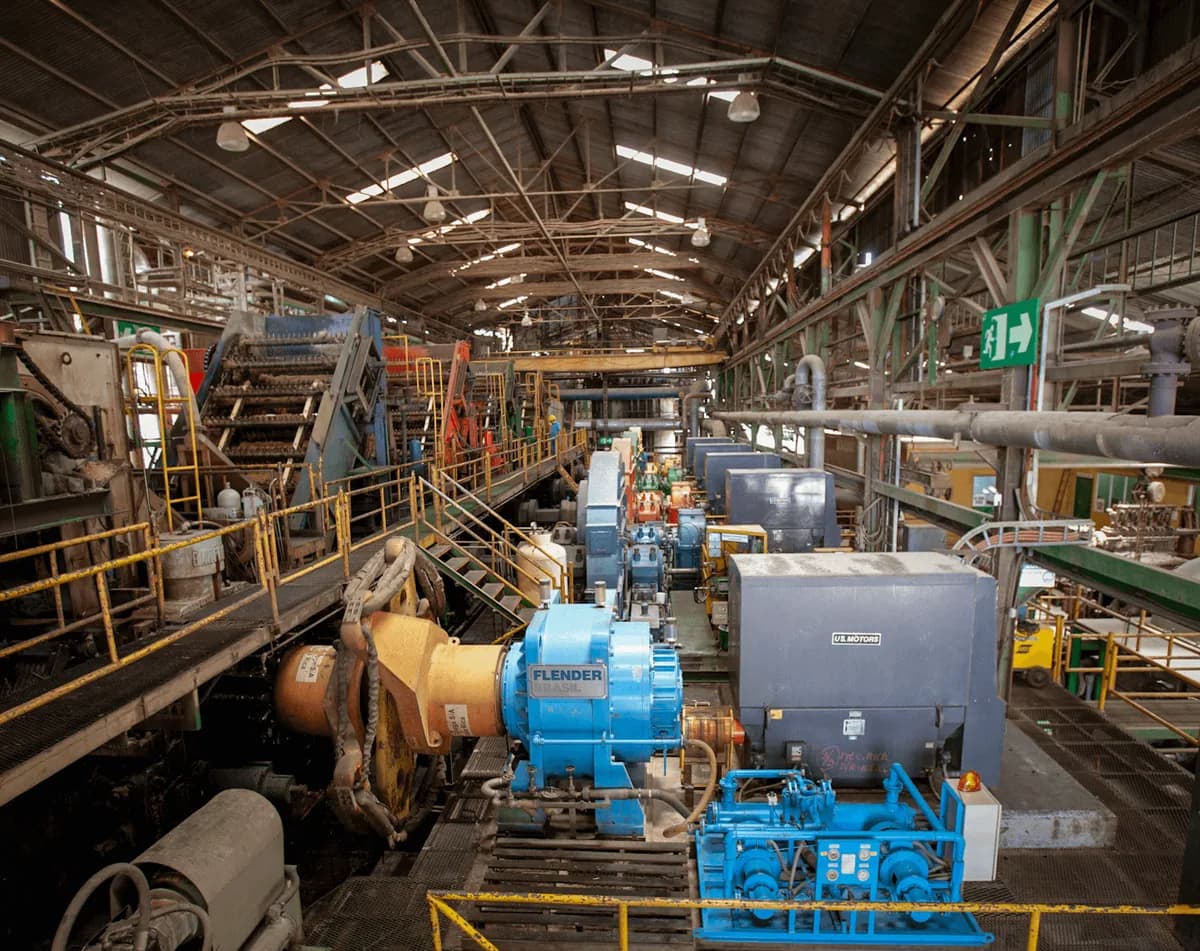
Sugar mill automation is built motor by motor. From the feeder tables that receive the cane to the conveyors carrying packed sugar, the mill is an unbroken chain of electric motors — many of them high-inertia, heavy-duty loads — that must start without shocking the grid, run at the right speed, and warn before they fail. Variable frequency drives (VFDs) and soft starters are the two tools that make that control possible.
In Guatemala this matters in a particular way. The sugar industry is one of the country's most important — Guatemala ranks among the world's largest sugar exporters — and it is concentrated on the south coast, in the department of Escuintla. During the zafra, the harvest season running roughly from November to May, the mill runs 24 hours a day, 7 days a week. In that context, a single hour of unplanned downtime is extremely costly: not only is production lost, but the already-cut cane moving through the process is lost too. Reliability, controlled starts, and load monitoring stop being an optional upgrade and become part of the operation.
This guide is prepared by the technical team at E3 Solutions, the official Emotron distributor in Central America. We walk the mill chain stage by stage and explain which type of drive fits each application, based on the Emotron catalog of variable frequency drives, soft starters, and shaft power monitors. See the full Emotron line → · See industrial automation →
Cane reception and preparation
Cane enters the mill at the reception yard and passes through the first line of motors: feeder tables, carriers, and conveyors that move the cane toward the milling tandem, and the preparation equipment — knife sets, choppers, and shredders — that opens the fiber to release the juice. This is the stage of the mill's hardest starts.
Choppers and shredders are high-inertia loads: heavy rotating masses that are difficult to set in motion. A direct-on-line start on this equipment hits the grid with a current peak several times the motor's nominal current and subjects belts, couplings, and bearings to a sharp jerk on every start. For motors that run at constant speed — like many choppers and shredders — an Emotron TSA soft starter ramps voltage up gradually and, thanks to its continuous three-phase torque control, keeps acceleration constant even under the variable load of the cane. Inrush current is cut by up to about 30%.
For feeder tables and carriers where the mill needs to regulate how much cane enters the process, the solution is a variable frequency drive: adjusting belt speed feeds the milling tandem evenly and avoids jams. If the question is which of the two devices fits each motor, the Variable frequency drive vs soft starter → guide explains it in detail.
Torque control and gradual starting for choppers, knife sets, and shredders.
See Emotron TSA soft starters →
Milling: mills and the tandem
The heart of the mill is the milling tandem, where prepared cane passes between the rolls to extract the juice. It is one of the most demanding applications in the whole process: heavy loads, high and variable torque, and the need to hold a stable milling speed so extraction is not compromised.
This is a heavy-duty variable frequency drive application. The Emotron VFX is designed precisely for dynamic and demanding applications — crushers, mills, mixers — and offers direct torque control, accurate speed control, and efficient vector braking. In milling, direct torque control lets the mill hold the right speed even as the cane load changes from one moment to the next, and the drive lets the operator adjust tandem speed to match the cane flow coming from preparation. The result is steadier milling and better use of the equipment.
The Emotron VFX, a heavy-duty drive for mills and demanding applications.
See Emotron variable frequency drives →
Bagasse handling
After the juice is extracted, bagasse remains: the fiber of the already-milled cane. Bagasse is moved by conveyors toward the boilers, where it is burned as fuel, and toward storage areas held in reserve. It is a continuous flow of bulk material on belts that can be long and that start with product already on them.
Starting a belt loaded with bagasse on a direct-on-line start causes a sharp jerk: the belt and material lurch, couplings and gearboxes suffer, and on long belts the material can shift or spill. An Emotron TSA soft starter applies a gradual start that sets the belt in motion without jolts, protecting the mechanical system and keeping the bagasse in place. For sections where the mill needs to regulate bagasse flow toward the boilers, a variable frequency drive lets the operator adjust belt speed to match steam-generation demand.
Boilers and steam generation
The mill's boilers burn bagasse to produce the steam that drives the entire process. Each boiler relies on two groups of fans: forced-draft fans, which push air into combustion, and induced-draft fans, which extract flue gases from the furnace. Adjusting the draft is what regulates combustion.
This is the classic variable frequency drive energy-savings application. Traditionally, draft is regulated with dampers while the fan keeps spinning at full speed — a method that wastes energy, because the motor draws almost the same amount whether the damper is partly closed or not. With a variable frequency drive, instead, the mill regulates draft by varying fan speed directly: when less air is needed, the fan turns more slowly and the motor draws proportionally less. The Emotron FDU is optimized precisely for flow and pressure control on fans, blowers, and pumps, and is available in IP20/21 and IP54 enclosures for demanding environments like the boiler area. For large fans that run at fixed speed, a soft starter protects the high-inertia blades and the belts during starting.
Variable draft = proportional energy
Regulating draft with dampers leaves the motor at full speed. Regulating it with a drive makes the fan turn only as fast as needed, and the motor draws in proportion. Exact savings depend on the fan and its operating pattern during the zafra.
Cogeneration with bagasse
One of the defining traits of the modern sugar mill is that it generates its own electricity. High-pressure steam produced by burning bagasse drives turbogenerators, and many mills on the south coast produce enough energy not only for their own operation but to deliver surplus to the national grid during the zafra.
Operating with on-site generation changes the rules for the rest of the mill's motors. An electrical grid backed by internal generation is more sensitive to starting peaks: a large motor started direct-on-line can cause voltage flicker and trip other loads. Here soft starters play a double role — they reduce the inrush current peak and spread that demand over time, protecting the stability of the internal grid. For applications that need to feed energy back to the grid in a controlled way, Emotron offers the AFE (Active Front End), a drive with regenerative capability. Power generation is, in fact, one of the sectors Emotron serves specifically.
Pumps throughout the process
A sugar mill is, to a large extent, a pumping plant. Across the process there are juice pumps, imbibition water pumps — the water added during milling to improve extraction — syrup pumps, boiler feedwater pumps, and service pumps. Many of them run continuously throughout the zafra.
For pumps, the Emotron FDU is the right drive: adjusting a pump's speed to match actual process demand saves energy compared with throttling by valve and allows fine control of flow and pressure. For pumps that run at fixed speed, an Emotron TSA soft starter brings two key protections: the linear soft stop eliminates the water hammer that damages pipes, check valves, and joints when flow is cut abruptly, and the built-in load monitor detects dry running, jams, and blockages using the motor's own current as the sensor, with no extra pipe instrumentation. For dedicated supervision of a pump's mechanical power, the Emotron M20 shaft power monitor detects overload and underload instantly using the motor as the sensor. To go deeper on this topic, see the motor control for pumps → guide.
Clarification, evaporation, and sugar centrifuges
Once extracted, the juice goes through clarification — where impurities are separated — and evaporation, which concentrates the juice into syrup and then into massecuite. These stages rely on pumps, agitators, and process equipment where the variable frequency drive provides the speed control needed to hold stable conditions, and soft starters protect the motors that run at constant speed.
The most demanding point of this phase is the sugar centrifuges, the machines that separate sugar crystals from the molasses. There are two types: batch centrifuges, which work in cycles — load, spin at high speed, discharge, repeat — and continuous centrifuges. Batch centrifuges are a cyclic, demanding application: they accelerate a large rotating mass up to high speed and then brake, over and over, throughout the zafra. It is an ideal case for a variable frequency drive like the Emotron VFX, whose direct torque control and efficient vector braking handle exactly this kind of accelerate-and-brake cycle with high rotational inertia. Precise torque control on the acceleration ramp is the same capability put to use in other high-inertia applications, as explained in the motor control for cranes → guide.
| Stage | Application | Recommended Emotron drive |
|---|---|---|
| Clarification / evaporation | Process pumps and agitators | FDU (variable speed) or TSA (fixed speed) |
| Batch centrifuges | Accelerate-and-brake cycle with high inertia | VFX — direct torque control and vector braking |
| Continuous centrifuges | Operation at sustained speed | VFX or FDU depending on the control requirement |
Indicative selection. Final sizing depends on the power, voltage, and specific application of each motor.
Packaging and finished-product conveyors
The end of the chain is dry sugar, ready to pack. The finished-product conveyors move bags and packed sugar toward the warehouse and dispatch. Although these are lighter loads than those on the milling side, they still benefit from motor control.
A soft starter on these conveyors ensures a jolt-free start that protects the packed product and the couplings; a variable frequency drive lets the operator synchronize speed between belt sections and match it to the pace of the packaging line. The principle is the same one that runs through the whole mill: every motor starts in a controlled way, runs at the right speed, and warns before it fails.
The Emotron line and the role of E3 Solutions
Across the sugar mill, the same two families of equipment appear again and again. It is worth being clear about what each one does:
- Emotron TSA soft starters — for constant-speed motors: choppers, shredders, large boiler fans, bagasse conveyors, service pumps. The TSA covers a range of 5.5 to 1000 kW, with supply voltages of 200–525 V or 200–690 V three-phase. It includes as standard three-phase torque control, an internal bypass, a thermistor input, an integrated load monitor, and smart stops — linear/soft for pumps, quick/brake for mills. It cuts inrush current by up to about 30%.
- Emotron variable frequency drives — the FDU for flow and pressure control on pumps and fans (the boiler energy-savings application), and the VFX for dynamic, demanding applications: mills, centrifuges, preparation equipment. For higher-power installations, Emotron also offers medium-voltage drives.
- Emotron M20 shaft power monitor — to supervise the mechanical load of pumps and critical equipment and act before damage occurs, using the motor itself as the sensor.
E3 Solutions, as the official Emotron distributor in Central America, does more than supply the equipment: it sizes the right drive for each motor according to its power, voltage, and application, supports commissioning, and backs the operation with after-sales service. In a mill, where the installation window between harvest seasons is short and the wrong equipment means downtime during the zafra, that technical support is part of the value. If you want to review the concepts first, read What is a soft starter? →.
Soft starters, variable frequency drives, and power monitors for industry.
See the full Emotron line →
The mill runs motor by motor
The sugar mill is one of the most demanding industries for motor control: high-inertia loads in cane preparation, heavy torque in milling, energy savings on the boiler fans, demanding cycles in the centrifuges, and continuous pumping across the whole process. Automation is not a single project but a motor-by-motor decision — a soft starter where speed is constant, a variable frequency drive where it must be regulated or torque controlled.
During the zafra, with the mill running 24/7, that decision is measured in reliability: controlled starts that do not shock the grid, protection that warns before failure, and a local supplier that sizes the right equipment. E3 Solutions, the official Emotron distributor in Central America, supports that process with product, sizing, and service.
Frequently asked questions
Automate the motor control of your sugar mill
Tell us which area of the mill the motor is in — preparation, milling, boilers, centrifuges, pumps — and its approximate power. We'll reply with a technical recommendation at no cost or commitment.