RESOURCES · EMOTRON
Pump motor control: Emotron soft starters and VFDs
A pump is, at its core, a motor with a hydraulic load. How that motor starts, stops, and runs decides the life of the piping, the energy bill, and the reliability of supply. This guide explains how Emotron soft starters and variable frequency drives control pump motors.
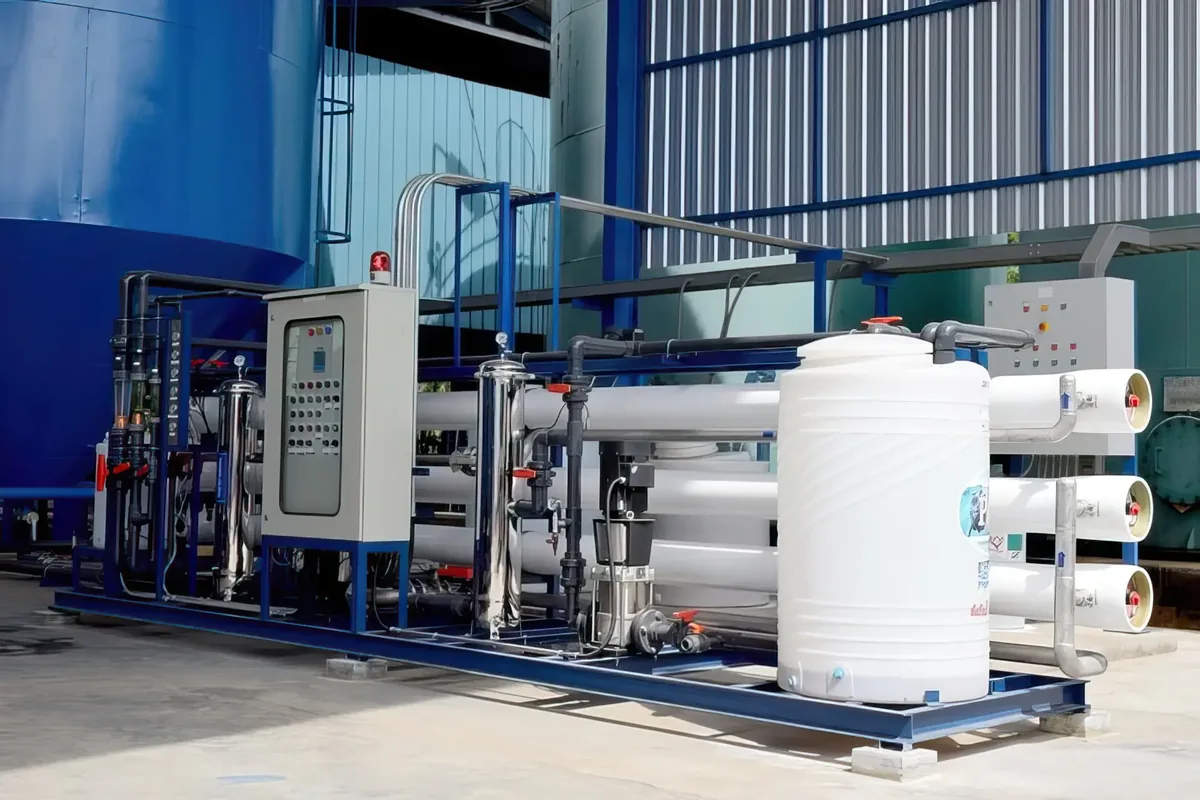
Pump motor control is not a minor technical detail: it is what separates an installation that lasts decades from one that spends its life repairing pipes, valves, and motors. Every pump — a surface centrifugal, a submersible well pump, or a pressure-boosting pump — is an electric motor coupled to a hydraulic load. How that motor starts, stops, and runs determines three concrete things: how much the pipe network suffers, how much energy the system consumes, and how reliably water reaches its destination.
In practice, nearly every pumping problem comes down to two. The first is water hammer: the pressure surge that occurs when flow starts or stops abruptly, eventually breaking joints, check valves, and the piping itself. The fix is a soft starter with a smooth stop. The second is the lack of flow and pressure regulation: a pump that always runs at a fixed speed delivers more than the process needs most of the time, and that shows up on the electricity bill. The fix is a variable frequency drive.
This guide is written by the technical team at E3 Solutions, the official Emotron distributor in Central America. It explains the pump types that exist, how a soft starter solves water hammer, how a VFD regulates flow and saves energy, how a pump is protected against dry running, and when each device is the right fit. If you already know what you need, see the Emotron TSA soft starters → or the Emotron variable frequency drives →.
Pump types and why motor control matters
Before choosing how to control the motor, it helps to be clear about the type of pump being driven, because each one reacts differently to starting, stopping, and speed variation. These are the five most common types in industry and in Guatemala's water utilities.
Centrifugal pumps
The most common type. They move water through the force of a spinning impeller. They have moderate inertia and respond very well to both soft starting and speed control: a small reduction in speed noticeably lowers the power consumed. They are the natural candidates for a variable frequency drive when flow or pressure must be regulated.
Submersible pumps
The motor and the pump form a single unit submerged in the water. They are used in wells, cisterns, and sumps. An abrupt start punishes the coupling and the submersible cable; an abrupt stop generates water hammer throughout the discharge piping column. Proper start and stop control significantly extends the life of equipment that is also expensive to pull out for maintenance.
Deep-well pumps
Submersible or vertical-shaft pumps installed at great depth. The water column above the pump is long and heavy, so water hammer is especially severe. In addition, if the aquifer level drops, the pump can run out of water and operate dry. Here motor control serves two critical functions: a smooth stop and protection against dry running.
Booster (pressurization) pumps
They maintain pressure in the water networks of buildings, condominiums, hotels, and irrigation systems. Demand changes constantly throughout the day. A fixed-speed booster pump starts and stops many times, or works against a throttling valve and wastes energy. A variable frequency drive adjusts speed to hold a constant pressure without repeated starts and stops.
Positive displacement pumps
Screw, piston, gear, or peristaltic pumps, used for viscous fluids or precise dosing. They cannot start against a closed discharge and need careful torque control. A controlled start prevents pressure spikes that damage seals and piping; when dosing is required, the VFD provides the speed control the process needs.
Water hammer: the problem of abrupt starting and stopping
Water hammer is the most common and most expensive cause of failure in pumping systems, and it almost always comes down to a detail that gets overlooked: how the motor starts and how it stops.
When a pump starts in direct-on-line (DOL) mode, the motor receives full voltage at once and accelerates abruptly. The water column, which was at rest, gets a violent push. When the pump stops abruptly — because power is simply cut — the opposite, and worse, happens: the moving water stops abruptly and all of its kinetic energy turns into a pressure surge that travels through the piping. That surge is water hammer. It shows up as an audible bang and, over time, breaks joints, check valves, pipe supports, and the piping itself. In deep wells, where the water column is long and heavy, the phenomenon is especially destructive.
The solution is a soft starter with a controlled stop. Instead of cutting power abruptly, the soft starter reduces voltage gradually: the motor decelerates progressively, the flow eases off smoothly, and the pressure surge never gets a chance to form. The Emotron TSA soft starter features smart stops: a linear/soft stop designed specifically for pumps, which eliminates water hammer, and a quick/brake stop for other applications such as mills and saws. The same gradual principle applies on the start, which also reduces wear on the coupling and the impeller.
If you want to fully understand what this device is and how it works, read What is a soft starter? →.
The soft stop in one sentence
Water hammer is not caused by how the pump runs, but by how it stops. A linear stop from the soft starter eases the flow off progressively and prevents the pressure surge from ever forming.
See the Emotron TSA soft starter and its smart stops →
Flow and pressure regulation: the variable frequency drive
Water hammer is solved at the start and the stop. But there is a second problem that lives throughout operation: a fixed-speed pump almost never delivers exactly what the process needs.
The traditional way to regulate the flow of a centrifugal pump is to throttle the discharge with a valve — that is, to make the pump work against an artificial resistance — or to let it start and stop repeatedly. Both are inefficient: the first wastes energy heating a valve; the second punishes the motor and the piping with water hammer cycles.
A variable frequency drive (VFD) solves the problem at the root: instead of throttling the flow, it adjusts the motor speed so the pump delivers exactly the flow or pressure needed at each moment. And here a physical principle comes into play that makes the VFD especially attractive on centrifugal pumps: the affinity laws. Conceptually, these laws state that the flow of a centrifugal pump is proportional to its speed, while the power it consumes grows with the cube of the speed. The practical consequence is striking: a modest reduction in pump speed produces a disproportionately large reduction in power. That is why, on any centrifugal pump that does not need to run at 100% all the time, a variable frequency drive translates directly into energy savings.
The Emotron FDU variable frequency drive is conceived precisely for this: it is Emotron's flow and pressure control drive, optimized for pumps, fans, and compressors. It covers a wide power range — roughly 0.75 to 4,000 kW, at 230–690 V — and is available in IP20/21 and splash-proof IP54 enclosures, a relevant feature in pumping stations and water treatment plants.
Explore the Emotron FDU variable frequency drive for pumps →
Protection against dry running and blockage
A pump that runs without water destroys itself. Dry running — when the well level drops, a suction valve closes, or a cistern empties — makes the pump spin without the liquid that cools and lubricates it. Within minutes, the seals and bearings are damaged. Blockage or jamming is the opposite problem: an object jams the impeller and the motor is overloaded. Both end in a burned-out motor and a pump out of service.
Traditional protection requires level, pressure, or flow sensors installed in the well or in the piping: extra instrumentation, external wiring, and bored holes that can fail or get fouled. The Emotron TSA soft starter offers a cleaner alternative: a built-in load monitor that uses the motor itself as the sensor. The unit calculates the motor's real load in real time; when that load drops below the configured threshold — an unmistakable sign that the pump is running without water — the starter acts before the motor is damaged. It detects jams and blockages the same way, since they show up as an overload. No pipe instrumentation or extra wiring is needed.
For installations that require more detailed power supervision independent of the start, Emotron also offers the M20 shaft power monitor. The M20 also uses the motor as a sensor — no external sensors, no holes in the pipes — and has an Auto Set function that establishes four protection set points in about 3 seconds based on the measured motor load. It instantly detects both overload and underload, and can issue a pre-alarm, an alarm, and a stop before damage occurs.
Soft starter or VFD? How to choose for a pump
This is the decision that most confuses anyone about to invest in pump motor control. The practical rule is simple.
A soft starter is enough when the pump must always run at its nominal speed and the only thing to control is starting and stopping. If your problem is water hammer, mechanical wear on starting, or protection trips from the inrush current, and the pump always delivers the same flow, the soft starter is the right and most economical solution. It solves water hammer with the soft stop and protects against dry running with the load monitor, without paying for a variable-speed function you will not use.
A variable frequency drive is the right choice when the process needs to vary flow or pressure during operation: a booster pump following changing demand, an irrigation system distributing water by sectors, a plant adjusting its output. It is also the obvious choice when the main goal is energy savings on a centrifugal pump that rarely needs to run at 100%, because the affinity laws turn every speed reduction into real savings. A VFD can also start and stop the pump smoothly, so it covers the water hammer problem as well.
| If your pump… | The right solution |
|---|---|
| Always runs at a fixed speed and only causes trouble on start or stop | Soft starter — solves water hammer and protects against dry running |
| Must regulate flow or pressure to match demand | Variable frequency drive — adjusts motor speed to the process |
| Is centrifugal and rarely needs to run at 100% | Variable frequency drive — affinity laws turn every speed reduction into savings |
| Is a pressurization booster in a building or condominium | Variable frequency drive — holds constant pressure without repeated starts and stops |
In short: if you only need to control starting and stopping, a soft starter; if you need to regulate flow or pressure — or want to save energy — a variable frequency drive. For an in-depth analysis of this decision, read Variable frequency drive vs soft starter →. If your application is about controlled motion rather than pumping — a crane, for example — see also Crane motor control →.
Pump control in Guatemala
Pumping is everywhere in Guatemala's infrastructure, and in every case good motor control changes the operating and maintenance numbers.
- Municipal drinking water. Municipalities operate wells and pumping stations that supply entire neighborhoods and county seats. A repeated abrupt stop fractures distribution piping that is expensive to replace and leaves sectors without water. Controlled starting and stopping, plus protection against dry running when the aquifer drops, are investments that pay for themselves.
- Agricultural irrigation. Coffee, sugarcane, banana, and vegetable crops depend on pumping systems for irrigation. A variable frequency drive lets you adjust the flow by irrigation sector and take advantage of the affinity laws to reduce electricity consumption, a significant cost on any farm. In the specific case of sugarcane, pumping is only one part of the process: see also Sugar mill automation →.
- Buildings and condominiums. The booster pumps that pressurize the water of residential towers, hotels, and offices work against demand that changes hour by hour. A VFD holds pressure steady and quietly, without the constant starts and stops that bother residents and wear out the equipment.
- Water treatment plants. Raw water, process water, and sludge pumping, plus reverse osmosis systems. The splash-proof IP54 enclosure of the Emotron FDU drive fits these humid environments.
- Deep wells. Common in areas without a municipal network and in agriculture. The long water column makes water hammer and dry running serious risks; motor control is practically mandatory.
E3 Solutions integrates these systems as part of its industrial automation practice, with the sizing and local support that imported equipment does not offer. Tell us about your pumping system on WhatsApp →, pump type ___, power ___ kW"))
The Emotron lineup for pumps and E3's role
Emotron — a brand of the Swedish firm CG Drives & Automation AB — manufactures industrial drive equipment designed to protect motors and rotating machinery. For pumping applications, three products cover most cases:
- Emotron TSA soft starter. Emotron's torque-control softstarter. It covers 5.5 to 1000 kW, at supply voltages of 200–525 V or 200–690 V three-phase. It reduces starting current by up to roughly 30%, includes an internal bypass and input thermistor as standard, motor thermal protection with a standard PTC input and up to 6 PT100 sensors, a built-in load monitor for dry running and jams, and the smart stops — linear/soft for pumps — that eliminate water hammer.
- Emotron FDU variable frequency drive. The flow and pressure control drive, optimized for pumps, fans, and compressors. Power range of roughly 0.75 to 4,000 kW, 230–690 V, available in IP20/21 and splash-proof IP54 enclosures.
- Emotron M20 shaft power monitor. A supervision instrument that detects overload and underload using the motor as a sensor, with an Auto Set function that sets four protection set points in about 3 seconds.
E3's value is not only in the product. As the official Emotron distributor in Central America, E3 offers regional stock, equipment sizing based on motor power and the pump curve, on-site commissioning, and local after-sales support. See the full Emotron line → or, if your project goes beyond controlling a single pump, E3's industrial automation → practice.
See the full Emotron line →
Controlling the motor means controlling the pump
A pump lasts as long as its motor and its piping last, and both depend on how starting, stopping, and speed are controlled. The water hammer that breaks joints and valves is eliminated with a soft starter and its linear stop. The wasted energy of a pump that always runs at full speed is corrected with a variable frequency drive and the affinity laws. The dry running that burns out motors is prevented with the built-in load monitor.
The rule for deciding is direct: a soft starter if you only need to control starting and stopping, a variable frequency drive if you need to regulate flow or pressure. If in doubt, read the full comparison between VFD and soft starter → or write to us: with the pump type and the motor power, we give you a technical recommendation at no cost.
Frequently asked questions
Get a quote for your pump's motor control
Message us on WhatsApp with the pump type, the motor power, and the line voltage. We reply with the technical recommendation — soft starter or VFD — at no cost or commitment.